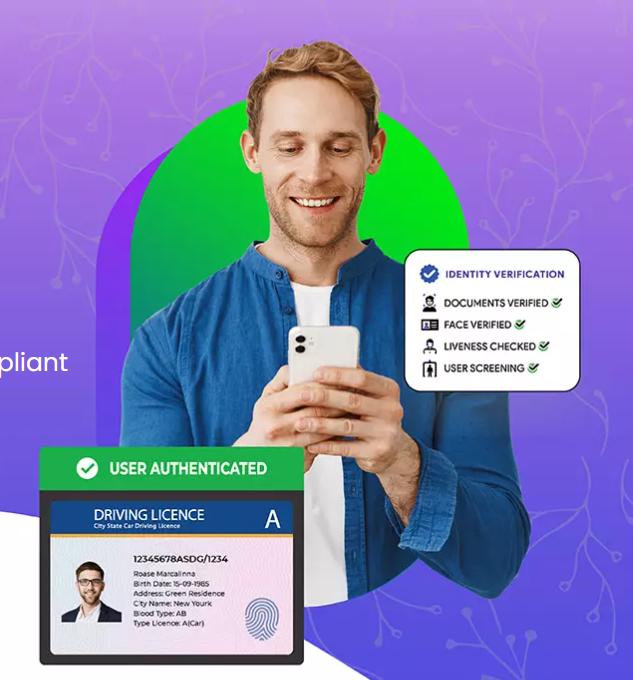
Face Liveness Check & Voice Biometrics Authentication for Secure Identity Verification
As digital services continue to expand, businesses need reliable ways to verify that users are genuine and not fraudulent. Traditional passwords, PINs, and security questions can be stolen, shared, or compromised. This has increased the demand for advanced biometric technologies that can verify identity while providing a convenient user experience. Two important technologies gaining attention are Face Liveness check and voice biometrics authentication.
By combining facial and voice-based verification, organizations can create stronger identity verification processes for banking, fintech, healthcare, recruitment, e-commerce, telecommunications, and other digital services.
What Is a Face Liveness Check?
A Face Liveness check is a security process designed to determine whether the face presented during an identity verification session belongs to a real, physically present person. It helps distinguish a genuine individual from presentation attacks such as photographs, videos, screen replays, masks, or other manipulated representations.
During a liveness check, the system analyzes facial characteristics and visual signals captured through a device camera. Depending on the technology, verification may be passive or active. Passive liveness detection can evaluate the user's face without requiring specific movements, while active methods may ask the individual to perform an action such as turning their head or following an on-screen instruction.
This additional layer is important because facial recognition alone may identify a face without necessarily confirming that the person is physically present.
Why Face Liveness Detection Matters
Digital identity fraud has become increasingly sophisticated. Attackers may attempt to use stolen identity information together with manipulated images or videos to bypass verification systems.
A reliable Face Liveness check can help businesses strengthen their identity verification workflows by detecting signs associated with spoofing attempts. It can be integrated into onboarding, account recovery, transaction verification, remote KYC, and access-control processes.
For businesses handling sensitive customer information, liveness detection can therefore support a more robust approach to digital identity security.
Understanding Voice Biometrics Authentication
Voice biometrics authentication uses unique characteristics of an individual's voice to help verify their identity. Instead of relying only on passwords or security questions, a voice biometric system analyzes characteristics within a person's speech and compares them against an enrolled voice profile.
Voice characteristics can include vocal patterns, speech characteristics, and other measurable features. Advanced systems can process these signals using artificial intelligence and machine learning techniques to support identity verification.
Voice biometrics can be useful for customer authentication, contact centers, financial services, telecommunications, healthcare platforms, and other applications where users need secure and convenient access.
Benefits of Voice Biometrics Authentication
One of the key advantages of voice authentication is convenience. Users can authenticate themselves through their voice without remembering another password or entering lengthy credentials.
It can also support faster authentication in environments such as contact centers. Instead of repeatedly answering security questions, an authorized user may be verified through their voice as part of a broader authentication workflow.
Modern voice biometric solutions can also be designed with anti-spoofing capabilities to help identify suspicious or manipulated audio. This is increasingly important as synthetic speech and AI-generated audio become more accessible.
Combining Face and Voice for Stronger Verification
Using multiple biometric signals can provide an additional layer of identity assurance. A Face Liveness check evaluates whether a real person is physically present in front of the camera, while voice biometrics authentication evaluates characteristics associated with the user's voice.
Together, these technologies can support multi-modal biometric verification. For example, during a remote onboarding process, a user could complete facial verification with liveness detection and provide a voice sample as an additional authentication factor.
This approach can help organizations build identity workflows that are both secure and user-friendly.
Applications Across Different Industries
Face liveness and voice biometrics can be applied across numerous industries.
Banking and fintech: Financial organizations can use biometric verification during customer onboarding, account access, and high-risk transactions.
Healthcare: Biometric authentication can help protect access to digital healthcare services and sensitive patient information.
Recruitment: Organizations can strengthen remote identity verification during candidate onboarding and reduce risks associated with impersonation.
Telecommunications: Voice and facial verification can support secure customer authentication and account management.
E-commerce: Businesses can introduce biometric verification for sensitive account activities and fraud prevention workflows.
Building a More Secure Digital Identity Ecosystem
Neither facial nor voice verification should necessarily be viewed as a standalone security solution. Effective identity verification generally combines biometric technologies with document verification, fraud detection, device intelligence, risk assessment, and other security controls.
Organizations should also consider privacy, consent, data protection, system accuracy, accessibility, and appropriate retention practices when implementing biometric solutions.
Conclusion
The growing sophistication of digital fraud has made advanced identity verification increasingly important. A Face Liveness check can help determine whether a real person is physically present, while voice biometrics authentication can provide an additional method for verifying users through their unique vocal characteristics.
When integrated into a broader identity verification strategy, these technologies can help businesses create secure, convenient, and scalable digital experiences. As biometric technology continues to evolve, combining multiple verification signals can play an important role in building greater confidence in digital identities.



About Premium Author
This post has been authored and published by one of our premium contributors, who are experts in their fields. They bring high-quality, well-researched content that adds significant value to our platform.
.png)